

LEPIS AUM
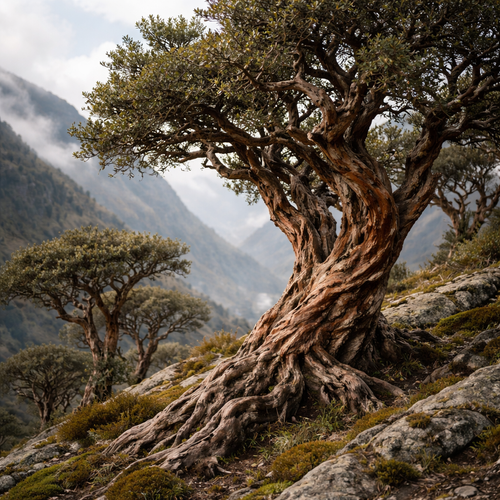
Lepis Aum is the defining structural Aum of Zoah, recognized by its twisted trunk, layered bark, and dense highland growth across the realm’s mountain ridges and clouded elevations. Its silhouette is low, weathered, and unmistakable, shaped by altitude, wind, and endurance rather than abundance.
Though harsh in appearance, Lepis Aum is one of Zoah’s most essential flora. Its wood is harvested for structural use, controlled burning, and highland construction, making it foundational to settlement life in a realm where survival depends on materials that can withstand exposure, elevation, and cold firelit nights.
FIELD RECORD
Native Aum species of Zoah.
Zoah
Flora
- Twisted, weathered trunk and compact branching structure
- Layered peeling bark in ash-grey and red-brown tones
- Low, wind-shaped canopy adapted to exposed elevation
- Dense root systems gripping rocky highland terrain
- Forms clustered groves across steep mountain ridges
Lepis Aum grows in clustered groves across ridgelines, steep slopes, and exposed mountain terrain, where its root systems help stabilize soil and endure harsh wind conditions.
Its wood is used for structural framing, firewood, reinforcement, and practical highland construction. It is valued less for abundance than for resilience and dependable burn quality.
Harvested selectively from mature growth or fallen sections, with grove stability prioritized over large-scale cutting. Use is tied to need and terrain access rather than a narrow seasonal cycle.
Most often found along mountain ridges, upper slopes, cloud forest edges, and highland groves throughout Zoah.
ARCHIVAL NOTE
Lepis Aum is easier to identify by shape than by leaf. From a distance, its groves read as low, wind-drawn forms pressed against the ridges, holding the line of the mountain rather than rising cleanly above it.
Up close, the bark reveals its age in layers—peeled, tightened, and hardened by exposure. It is not a graceful Aum, nor one prized for softness. In Zoah, it is valued because it lasts.