

MELZARI
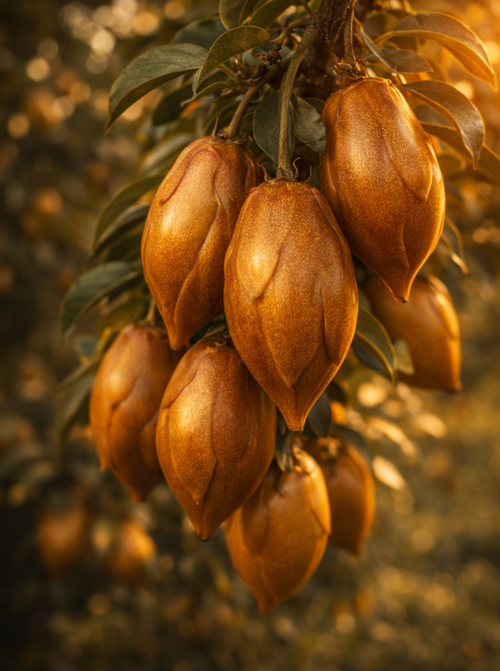
Melzari is a cultivated orchard fruit of Sutra, grown alongside Solthara within the terraced rows of Kingsroot Orchard and the wider heartlands. Where Solthara carries the warmth of open sun, Melzari develops in slightly deeper shade, its form shaped by softer light and longer maturation.
The fruit is elongated with gently flowing contours, its surface marked by subtle ridges rather than sharp definition. Its coloration settles into tones of honey-gold, amber, and deepened bronze near the stem, with a grounded richness that reflects its slower growth. In Sutra, Melzari is valued for its depth—less bright, but more complex, offering a quiet counterpart to the orchard’s brighter yields.
FIELD RECORD
Cultivated orchard fruit native to Sutra, developed through structured agricultural practice.
Sutra
Flora
- Elongated fruit with smooth surface and soft ridge-like contours
- Color ranges from honey-gold to deeper amber and bronze tones
- Grows in small clustered formations along orchard aums
- Surface carries a subtle matte warmth rather than reflective shine
- Heavier visual tone compared to brighter orchard fruits
Melzari is cultivated in structured orchard rows, often positioned where canopy or terrain creates slightly softened light conditions.
Consumed fresh, pressed, or used in richer preparations and preserves. Also traded as a refined orchard fruit with deeper flavor complexity.
Harvested later in the orchard cycle, once the fruit has deepened fully in color and internal sweetness.
Primarily found in Kingsroot Orchard and across Sutra’s cultivated terraces, often in areas with partial canopy or filtered light.
ARCHIVAL NOTE
Melzari reflects a quieter side of Sutra’s abundance—one that does not rely on brightness or immediate appeal. It matures with time, deepening in both tone and character, shaped by conditions that favor patience over speed.
In the Realm of Plenty, not all growth is meant to stand in the open sun. Some is meant to develop in balance with shadow, gaining strength through restraint. Melzari stands as a counterpart within the orchard—a reminder that abundance is not singular, but layered.