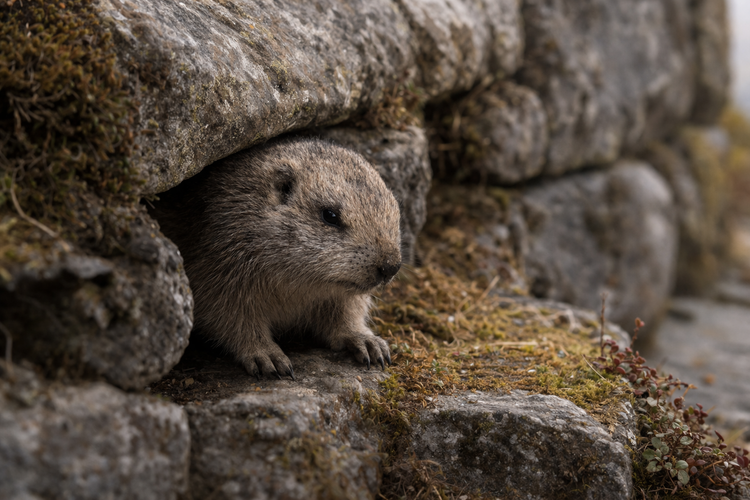
Tukal are small burrowing rodents native to the stone terraces and compacted highland soils of Zoah. Most often found beneath fitted rock, moss-lined cracks, and narrow earth channels between terrace walls, they remain largely hidden unless emerging to feed, clear tunnels, or assess disturbance near the surface.
Though easy to overlook, Tukal play an important role in Zoah’s smaller ecological systems. Their digging aerates compact soil, shifts fine debris between stone layers, and supports the movement of moisture through tightly packed terrace ground. They also serve as prey for larger predators throughout the realm.
FIELD RECORD
Small highland burrowing rodent adapted to stone-integrated soil systems and terrace foundations.
Zoah
Low-level burrower and prey species contributing to soil turnover and small-scale ecological cycling.
- Compact, low-built body
- Short, powerful forelimbs for digging
- Dense coarse fur dusted by stone and soil
- Blunt face with small dark eyes
- Burrow emergence through narrow stone gaps
Terrace walls, stone seams, compacted soils, moss-lined cracks, and sheltered ground pockets across Zoah’s highland regions.
Tukal remain below ground for extended periods, emerging cautiously and only partially when surface conditions feel stable. They are highly responsive to vibration and nearby movement.
- Efficient digging through compact terrace soil
- Burrow construction between fitted stone layers
- Low-profile movement in narrow ground spaces
- Adaptation to cold and low-light environments
Most active during quieter surface periods when foot traffic, predator movement, and weather exposure remain low.
Tukal are an important prey species within Zoah and contribute indirectly to the health of cultivated and semi-wild terrace ground through constant burrow activity.
None